
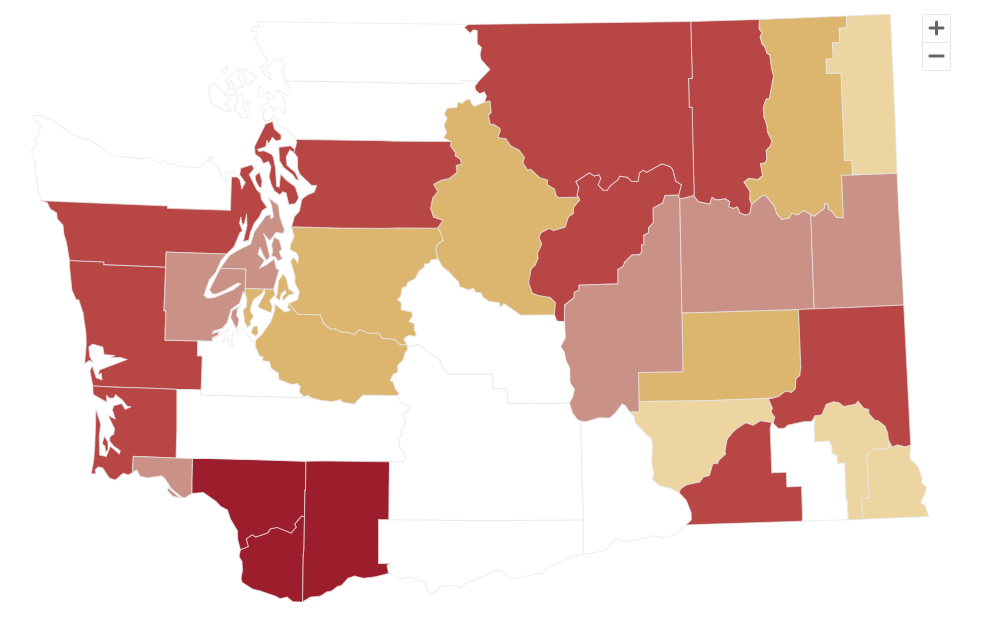
Washington is well known for being made up of many different biomes. The middle of the state is comparable to a desert; the west is dominated by coastlines, and there are massive forests throughout. All four seasons are regularly represented, and the state is known for hot summers and cold winters. Unfortunately, this variety is reflected in the versatility of its natural disasters. The Federal Reserve Bank of New York has a tool for documenting this; its Losses from Natural Disasters Tool contains an interactive map by state and county for the entire US. It can be broken down into 12 different categories. These are Coastal, Drought, Flood, Hail, Heat, Hurricane/Tropical Storm, Thunderstorm/Rain, Tornado, Tsunami/Seiche, Wildfire, Wind, Winter Weather, and Other. The map represents damage in financial cost associated to events, and its primary data source is the National Oceanic and Atmospheric Administration’s (NOAA) Storm Events Database (SED).
Washington State has annual data running back to 1996, and the results likely aren't surprising for which categories have caused the most damage. Most damages across the state over this thirty-year period were caused by wildfire, flooding, and wind. The worst year by financial damage was 2020, with over one billion dollars in damages from wind alone and another 300 million dollars from flooding. Behind this, the next worst years were 2024 and 2025, with ~550 million dollars in damages both years from wildfires. It appears likely 2026 will turn out similar once official numbers are released, based on the current fire season.
Walla Walla has not been treated too harshly by natural disasters. Their damages since 1996 come out to $23 million total. Unsurprisingly, 2020 was this county’s most costly year on record as well, with $10.7 million coming from flooding damage. The second most costly year was 2008; $6.9 million in wind damages. The remaining years are all varied; there doesn’t appear to be any increase in degree of disaster like can be seen with wildfires in the rest of the state.
To learn more about Walla Walla County, visit the Walla Walla Trends site here.